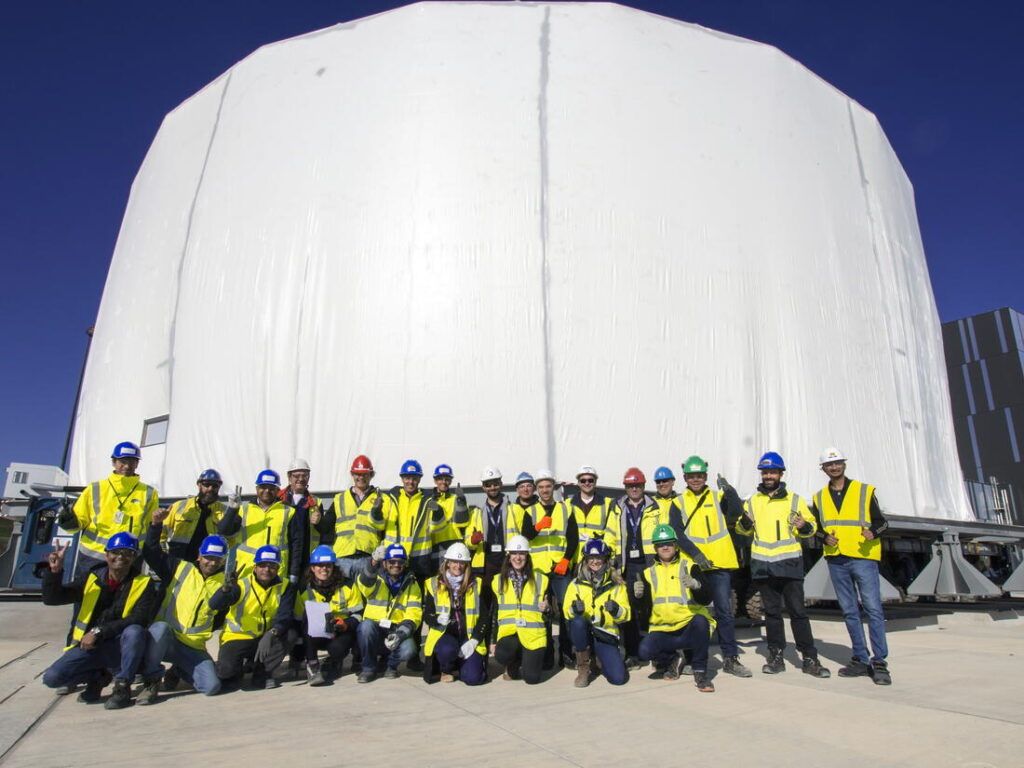
At the ITER nuclear fusion project in southern France, Cocoon Holland designed and implemented a mothballing solution to protect the lower cylinder of the ITER cryostat.
The 375-tonne component had to be moved into temporary outdoor storage before its installation in the ITER Tokamak. Cocoon Holland’s protective enclosure provided a hermetically sealed barrier against weather, moisture and dust, while internal air circulation and humidity control were designed to prevent corrosion and mould formation.
The 2,300 m³ enclosure successfully passed an airtightness test in May 2019.
Project overview
| Project | ITER nuclear fusion project |
| Location | Southern France |
| Component | Cryostat lower cylinder |
| Component weight | 375 tonnes |
| Approximate diameter | 30 metres |
| Protective enclosure volume | 2,300 m³ |
| Preservation method | Cocoon Mothballing System |
| Internal humidity | 38% target |
| Airtightness verification | Successful pressure test, May 2019 |
| Temporary outdoor storage | April 2019 – August 2020 |
What is the ITER project?
ITER, meaning “The Way” in Latin, is one of the world’s most ambitious international energy research projects.
Located in southern France, ITER brings together 35 nations to construct a tokamak, a magnetic fusion device designed to demonstrate the scientific and technological feasibility of fusion energy on a large scale.
The experimental programme aims to advance fusion research and support the development of future fusion power plants.
One of the major components of the ITER Tokamak is the cryostat, a large stainless-steel vacuum enclosure surrounding the machine and its superconducting magnet systems.
The cryostat consists of several large sections, including the base, lower cylinder, upper cylinder and top lid.
Cocoon Holland was involved in the preservation of the lower cylinder before its installation.
Why did the ITER lower cylinder require preservation?
The cryostat lower cylinder was completed in March 2019. However, it could not be installed immediately because the ITER construction and assembly process involved multiple successive stages.
At the same time, the Cryostat Workshop needed to be made available for the assembly and welding of the upper cylinder.
The completed lower cylinder therefore had to be transferred to an outdoor storage area, where it would remain until the next stage of installation.
This created a preservation challenge.
The large steel component needed protection against weather, moisture and dust during temporary storage. Preventing corrosion and mould formation was essential to the preservation strategy.
Cocoon Holland was commissioned to provide a mothballing solution for this large industrial component.
How did Cocoon Holland protect the ITER lower cylinder?
Creating a hermetically sealed protective enclosure
Cocoon Holland designed and implemented the mothballing technique used for the cryostat lower cylinder.
The component was wrapped in multiple layers of synthetic thermoplastic material. These layers were bonded together using a spray-applied adhesive to form a continuous protective enclosure.
The resulting synthetic skin hermetically sealed the component and protected it against external weather conditions, moisture and dust.
The protective covering was specifically applied to the large lower cylinder before it was moved into outdoor storage.
Protecting the component during outdoor storage
The enclosure provided the external barrier required for the preservation of the component.
However, effective mothballing also required control of the conditions within the enclosed space.
For this reason, the preservation approach combined the protective outer skin with continuous internal air circulation and humidity control.
How were conditions controlled inside the cocoon?
Inside the protective enclosure, air was designed to circulate continuously and relative humidity was to be maintained at 38%.
These controlled conditions were intended to prevent the formation of corrosion and mould while the lower cylinder remained in storage.
The distinction between external protection and internal environmental control is an important aspect of industrial mothballing.
The outer enclosure protects the component against weather, moisture and dust, while the internal environment is managed to reduce deterioration risks during storage.
How was the airtightness of the 2,300 m³ cocoon verified?
In May 2019, the protective cocoon surrounding the ITER cryostat lower cylinder underwent an airtightness test.
The enclosure contained approximately 2,300 m³ of air.
To check for potential leaks, air was pumped into the cocoon, increasing the internal pressure by a few dozen pascals above atmospheric pressure. The pressure was subsequently reduced by a comparable amount.
This procedure tested the integrity of the protective enclosure and its resistance to uncontrolled air exchange.
The protective cocoon successfully passed the airtightness test.
The result confirmed the integrity of the synthetic enclosure under the tested conditions, supporting the controlled atmosphere required for the preservation of the lower cylinder.
How was the protected lower cylinder moved into storage?
On 15 April 2019, the protected lower cylinder was moved from the Cryostat Workshop to an outdoor storage area on the ITER construction platform.
The transport operation required four self-propelled modular transporters (SPMTs) operating in coordination.
Together, they used 192 wheels to move the load, which weighed nearly 500 tonnes including the transport-related structures.
The operation included a demanding 90-degree turn before the load could reach its storage position.
The transport was carried out by specialized project partners, including heavy transport specialist Sarens, as part of a coordinated ITER operation.
Cocoon Holland’s responsibility concerned the weatherproof preservation enclosure and its assigned inspection activities.
The successful move freed space inside the Cryostat Workshop for the next stage of cryostat assembly.
How was the lower cylinder protected during storage?
Following the transfer in April 2019, the lower cylinder remained in temporary outdoor storage until August 2020.
The protective enclosure was intended to maintain suitable preservation conditions during this period.
The ITER Organization identified Cocoon Holland as responsible for weatherproof packing and biannual inspections as part of the project.
On 22 August 2020, the lower cylinder was transferred from storage into the Assembly Hall. On 31 August 2020, the component was lowered into the Tokamak assembly pit.
What were the documented results of the preservation project?
The ITER lower cylinder project provides several documented milestones:
- Cocoon Holland designed and implemented the mothballing technique for the lower cylinder.
- The 375-tonne component was enclosed in protective synthetic thermoplastic material.
- The enclosure provided a hermetically sealed barrier against weather, moisture and dust.
- The 2,300 m³ protective cocoon passed its airtightness test in May 2019.
- The component remained in temporary outdoor storage from April 2019 until August 2020.
- The lower cylinder proceeded to the next installation stage in August 2020.
These milestones document the preservation method, the verification of the enclosure and the subsequent project progression.
What can other industrial projects learn from ITER?
The ITER project illustrates a preservation challenge encountered in complex industrial construction and engineering projects: a large component is ready, but installation cannot yet take place.
When equipment must be stored before installation, protection requirements depend on the component’s materials, dimensions, expected storage duration and environmental conditions.
The ITER case demonstrates how a tailored protective enclosure, combined with internal air circulation and humidity management, can form part of an industrial mothballing strategy.
Similar preservation considerations may arise when large industrial equipment, machinery or fabricated components must remain in temporary storage while other project activities continue.
The appropriate conservation method must be determined for each application.
Frequently asked questions about the ITER preservation project
Why did the lower cylinder need temporary storage?
The Cryostat Workshop had to be made available for further assembly work, while the completed lower cylinder was not yet required for installation in the Tokamak pit.
How was the lower cylinder protected against corrosion?
Cocoon Holland applied a hermetically sealed protective enclosure. The preservation system was designed to circulate air continuously and maintain a controlled internal humidity of 38%.
How was the protective cocoon tested?
A pressure test was carried out on the 2,300 m³ enclosure in May 2019. The pressure was raised above and reduced below atmospheric pressure to test for potential leakage. The enclosure passed the test.
How long did the lower cylinder remain in outdoor storage?
It was moved into outdoor storage on 15 April 2019 and returned for assembly in August 2020, a period of approximately sixteen months.
Need to preserve large industrial components before installation?
Large equipment may require temporary storage when installation schedules, project phases or operational requirements do not allow immediate use.
Cocoon Holland develops industrial mothballing solutions based on the requirements of the equipment and its storage environment.
Discuss your preservation challenge and explore the appropriate protection method for your industrial components.
Learn more about the Cocoon Mothballing System.
Project updates and documentation
Cocoon Holland previously shared updates about its involvement in the ITER project, including:
These updates can be retained alongside the original project photographs.
For background on the wider construction project, visitors can also watch ITER – the world’s largest puzzle (2020 version).
Official ITER project references
- Sealed away in its cocoon — 8 April 2019
- A transfer that felt like art — 16 April 2019
- Comfy cocoon — 27 May 2019
- Cryostat fabrication on site — ITER construction archives
Originally published: 24 September 2018.